
Competency Assessments for Complex Care Staff
ENSURE COMPLIANCE AND CONFIDENCE
Structured, practical competency assessments to support safer care, clearer documentation, and greater confidence in practice.
For care providers, case managers, and teams supporting clients with complex clinical needs.
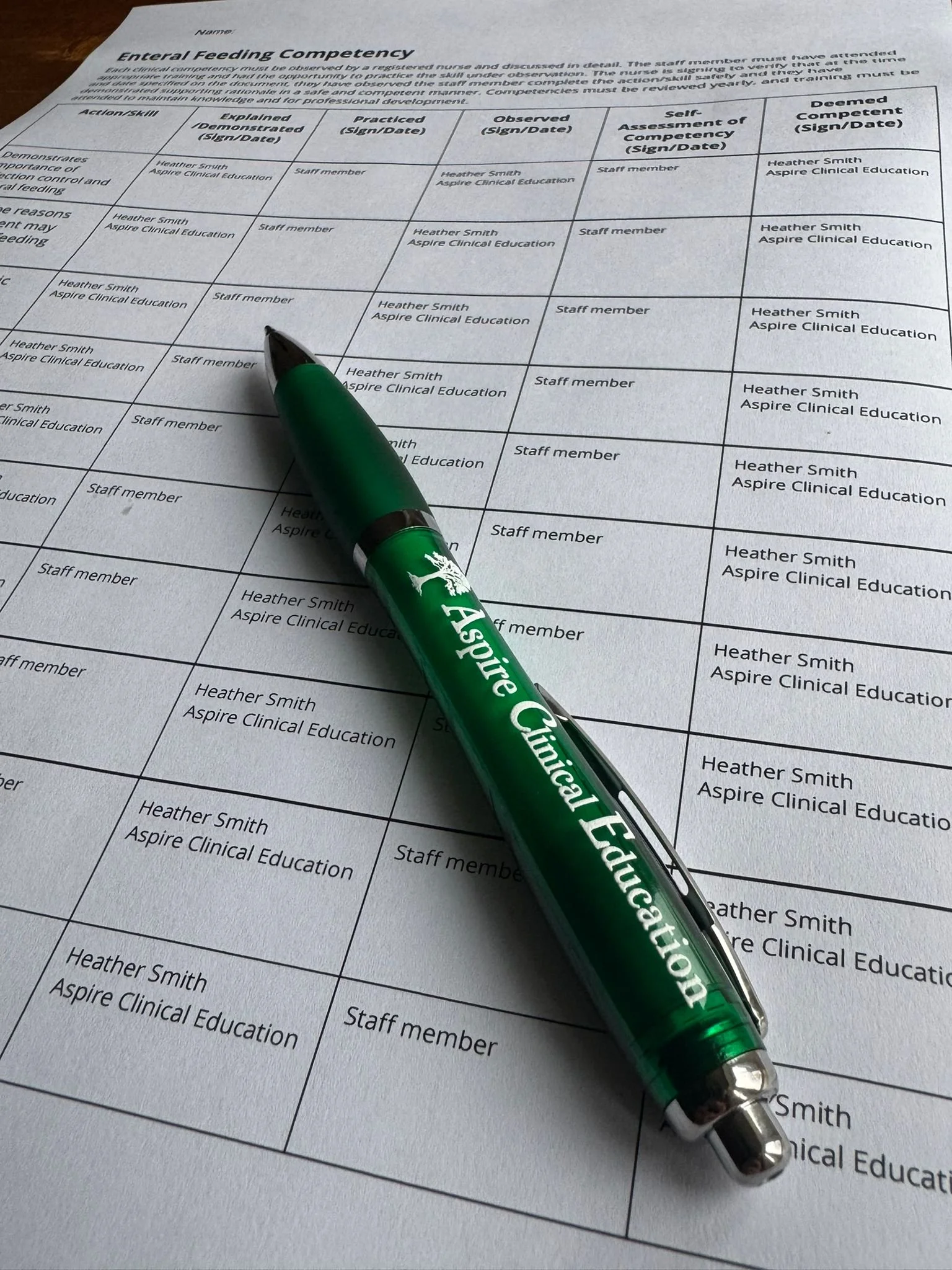
High quality training is an important foundation for safe care. However, attendance at training alone does not confirm competence. Competence should be assessed through observation of practice within the care environment and supported by the organisation’s clinical governance processes.
Why Competency Assessments Matter
Competency assessments help ensure that staff are not only trained, but able to apply their knowledge and skills safely in practice.
In complex care environments, staff often support clients with specialised equipment, clinical procedures, and individualised care plans. Competency assessment helps confirm that staff understand how to carry out these tasks safely, recognise potential complications, and know when to escalate concerns.
A structured approach to competency assessment can also support organisations with:
Safer care delivery
Improved staff confidence
Identification of learning needs
Clear documentation of staff development
Stronger clinical governance
CQC compliance
Training provides an important foundation for safe care, but competency assessment helps demonstrate that learning can be applied appropriately in the real care environment.
What Competency Assessment Support Can Include
Structured competency documentation
Direct observation of practice
Knowledge-based questioning
Scenario and simulation based assessments
1:1 competency support for complex needs
Feedback and development points
Support with identifying learning needs
| Competency Stage | Description |
|---|---|
Explained / Demonstrated |
The procedure is explained and demonstrated during training, including key safety considerations and escalation points. |
Practiced |
Learners have the opportunity to practice the skill during training in a supported environment. |
Observed in Practice |
The learner performs the skill while being observed. Some prompts or guidance may still be required at this stage. |
Self-Assessment of Competence |
The learner reflects on their confidence and readiness to perform the skill safely and independently. |
Deemed Competent |
Competence is confirmed once the skill can be performed safely and appropriately in practice. |
My Approach to Competency Assessments
My approach to competency assessment is structured, supportive, and focused on safe practice.
Competency assessment is not based solely on observing a task being completed. It also considers the knowledge, understanding, and decision-making that underpin safe clinical practice.
During assessment, staff may be expected to demonstrate:
Sound knowledge and understanding of the procedure, including relevant risks and escalation processes
Safe practical performance of the skill in line with best practice guidance
Awareness of complications and when to seek advice or escalate concerns
Confidence in carrying out the task, while recognising personal limitations
Engagement with the learning process, including discussion and reflection
Participation during training and assessment, asking questions and demonstrating understanding
This approach helps ensure that competency assessments reflect not only technical ability, but also the knowledge, judgement, and confidence required to deliver safe care.
Competence is assessed through a combination of knowledge, practical performance, and professional judgement, rather than training attendance alone.
Structured Competency Framework
Aspire Clinical Education uses a structured competency framework designed to support safe learning, progression of skills, and clear documentation of competency development.
This staged approach recognises that competency develops over time through explanation, practice, observation, and reflection, rather than through training attendance alone.
Competency documentation is developed in alignment with relevant clinical guidance, evidence-based practice, and regulatory expectations within health and social care.
The procedure is explained and demonstrated during training, including key safety considerations and escalation points.
Learners have the opportunity to practice the skill during training in a supported environment.
The learner performs the skill while being observed. Some prompts or guidance may still be required at this stage.
The learner reflects on their confidence and readiness to perform the skill safely and independently.
Competence is confirmed once the skill can be performed safely and appropriately in practice.
Competency documentation will break down individual components of a skill to support detailed assessment and clear documentation of progression.
Professional Scope and Governance
Complex care training and competency assessments are designed to support knowledge, practical skills, and safer care practice. However, they do not replace the responsibilities of the employing organisation in relation to recruitment, supervision, delegation, and clinical governance.
Training alone does not confirm competency. Competence is demonstrated through the safe application of knowledge and skills in practice.
For complex clinical skills, Aspire Clinical Education does not sign staff off as competent during a training session alone. Competency assessment may require direct observation of practice and, in some circumstances, may take place within the client’s care environment.
Where competency assessments are requested, Aspire Clinical Education can provide structured observation, feedback, and documentation to support staff development. Final decisions regarding delegation, authorisation, and whether a staff member is competent to deliver care remain the responsibility of the employing organisation and its internal governance processes.
Staff may require further supervised practice before they are able to safely perform clinical tasks independently.
Why Organisations Choose Aspire Clinical Education
Training and assessments are delivered by an experienced nurse with a background in intensive care and complex community care, bringing real-world insight into the challenges staff may encounter in practice.
Aspire Clinical Education offers:
practical, hands-on learning approaches
training informed by real clinical experience
structured competency assessment processes
training tailored to individual clients and care packages
a strong focus on safety, confidence, and clinical governance
The aim is to support care teams with the knowledge, practical skills, and confidence required to deliver safe and effective care.
FROM HEATHER TO YOUR TEAM
Competency Assessments
1) Get in touch
Talk to Heather to discuss your competency assessment needs. This may include information about the care package, clinical skills required, and the staff group involved.
2) Discussion and Planning
An initial discussion will help determine the most appropriate training or competency assessment approach. Where relevant, care plans or clinical guidance may be reviewed to ensure the training reflects the client’s care needs.
3) Training Delivery
Aspire Clinical Education provides comprehensive training to support knowledge, practical skills, and safe practice within complex care environments.
4) Competency Assessments
Competency assessments are carried out following completion of relevant training delivered by Aspire Clinical Education. Assessment may include observation of practice and discussion of knowledge to help ensure that staff can safely apply learning in practice.
Explore Related Training
FACE -TO-FACE · NURSE-LED · SMALL GROUPS

Need training tailored to your team or client?
I offer fully bespoke, client-centred training. I gather information beforehand so every session is completely personalised.
FREQUENTLY ASKED QUESTIONS
Competency Assessments
FAQ
-
Training supports the development of knowledge and practical skills, but training alone does not confirm competency in practice. Competence requires the ability to apply learning safely in the real care environment.
For complex clinical skills, Aspire Clinical Education does not sign staff off as competent during a training session alone. Competency assessment should involve direct observation of the skill being performed in the relevant care setting.
See blog post for more information on this.
-
Training supports learners to develop knowledge and practical skills. Competency assessment focuses on whether those skills can be applied safely in practice.
Competence is usually demonstrated through observation of practice, discussion, and task-specific questioning within the relevant care environment.
-
No. They are designed to assess knowledge and practical performance, and may also help identify where further training or support is needed.
-
Yes. Assessments can be aligned to the client’s care needs, relevant equipment, and the responsibilities of the team supporting them.
-
The employing organisation remains responsible for delegation, authorisation, and internal governance decisions.
-
Aspire Clinical Education confirms only that, at the time and date of assessment, the staff member demonstrated the required skills and supporting knowledge safely and competently under supervised training conditions. Aspire Clinical Education accepts no responsibility or liability for the individual’s subsequent performance, actions, or decisions made in the workplace after assessment.
-
If a staff member is not able to demonstrate safe practice during assessment, feedback will be provided to highlight areas requiring further support or learning.
The employing organisation can then decide on the appropriate next steps, which may include further training, supervised practice, or reassessment.
Regulators such as the Care Quality Commission (CQC) recognise the importance of supervision and support while staff develop competence. This may involve working alongside or under the supervision of a colleague who is already competent until the required standard is achieved.
Let’s talk about competency assessments
GET IN TOUCH
If you would like to discuss competency assessment for your care team or a specific client package, please get in touch!
PHONE


RESPONSE TIME
Usually within 24 hours